Care Studio opens on what is waiting
Summary, critical banner, and the review queue — what the doctor opens first.
For clinic owners
Results in. Clinic template assembled. A named doctor signs — then the patient copy releases and employers get aggregates only.
Not a medical device. It copies laboratory flags and doctor decisions. It does not diagnose, triage, or compute a clinical status.
Private pilot with a Singapore health-screening provider.
Hand-built reports cap the next employer account. Complete set in, clinic template out, named-doctor release — patient copy and employer aggregates in one layer.
The report looks like the clinic, employers never see one person, and a named doctor holds the veto.
Cover, wording and ranges follow the clinic’s template — the document a named doctor signs. White-labelling and custom domains settle under contract.
Workforce Health shows attendance and aggregate indicators — never one person. Under-ten stays hidden in the database, including arithmetic that would undo it. Monthly statements itemise services before invoice.
Assembles when the set is complete. Critical leaves the automatic path. Content signed off before use.
Laboratory result in. Clinic template out. Named doctor signs. Patient copy after release. Employers get aggregates and monthly statements.
Summary, critical banner, and the review queue — what the doctor opens first.
The doctor reads the clinic’s own report at reading size, acknowledges flagged results, and signs — unsigned pages cannot pass as signed.
Workforce Health shows participation and indicator mixes as aggregates — never one person’s results. Groups under ten stay hidden.
After release, My Health opens on the signed note first, then next actions.
Connection note. Laboratory and clinic-system feeds are named in the pilot checklist — not as a public supplier list.
Complete set in. Named doctor holds. Patient copy out. Demo screens: fictional Tembusu Health — not a customer clinic.
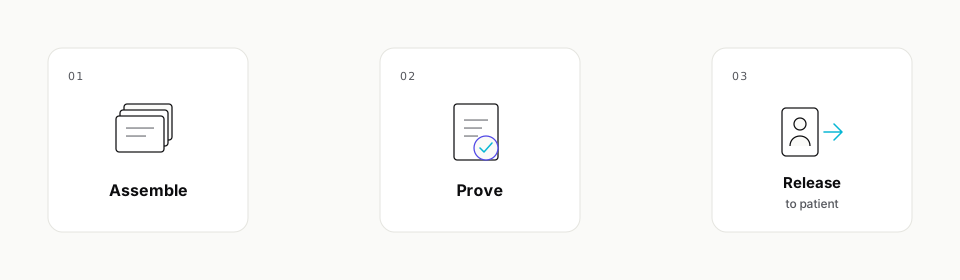
01 · Assemble
Complete set in — Care Studio queues the clinic’s report. The doctor opens on summary, critical banner, and cases ready to read.

02 · Prove
Named doctor reads at reading width. Source locks before release — later changes never rewrite what already left.

03 · Release to patient
After the named doctor signs, My Health opens on the signed note first, then next actions.
On the release path

Also in Care Studio / Workforce


Report Studio, Composer, and clinical assists — always under named-doctor release.
Report templates, screening packages, and content sign-off bound to a named responsible doctor. Your layout, your wording — sealed before release.
Compose, reorder, theme, and publish a workforce report — k≥10 locked; only signed, released reports enter the cohort.
Scribe drafts commentary for clinician review. A named doctor accepts, edits, or refuses before release. Does not diagnose or compute a clinical status.
Care Studio presents tiers from models the clinic configures and signs. Riverr renders that standing; a named doctor releases. No invented diagnosis.
† Assistive presentation only — a named doctor releases. Riverr does not diagnose. Never auto-released as clinical judgement.
Incomplete test, invalid range, mismatched code, or critical result — the report holds. SPECIMEN until a named doctor signs. Source locks; critical follows clinic protocol.
Private pilot: named owners on sites, senders, laboratory feeds, report design, package mapping, patient access, doctors verified. Scope settles before go-live.
Guided go-live
Bring your template and signing register. Email who you are and what you run.
Release controls procurement can verify. Security evidence and hosting terms settle in contracting and questionnaires.
Growth, brand, medical veto, privacy floor, and how pilots start.
Machine intake, auto-assembly when the set is complete, and employer aggregates in the same release layer — replacing hand assembly, re-keying, and slide-deck summaries. No headcount or cost-saving figure claimed.
Reports ship in the clinic’s own template. Patient and employer surfaces carry that brand. White-labelling and custom domains settle under contract.
The platform never computes a clinical status. Source is locked before release. Critical results leave the automatic path. Content is signed off before use. Only a named, registered doctor releases.
Employer reporting is aggregate only. A minimum group of ten is enforced in the database, including refusal of arithmetic that would undo it.
Private pilot is how clinics start. Scope, configuration checklist, and commercial terms settle before go-live — Talk to Riverr.
Full product, trust and commercial answers on the FAQ.
Private pilot for screening clinics. Bring your template and signing register — email who you are and what you run.
hello@riverr.net · Riverr Pte Ltd · Private pilot. Terms settle with the clinic — no fee tables here.